|
| Laser Hair Removal
|
Author :Dr Philippe Abimelec
Last scientific update: June 2003 |
|
 |
 |
| How
can the laser remove the hair ? |
|
 |
The
laser emits an invisible light which penetrates the skin without
damaging it; it is then absorbed by the pigments of the pilous follicle.
The laser light selectively absorbed by the follicle damages its
functions and impairs its ability to fabricate hair. At the level
of the pilous follicle, the laser light absorbed by the pigments
is then transformed into heat which damages the hair but not the
surrounding skin.
 |
| How
safe is laser hair removal ? |
|
 |
Laser
hair removal is an effective and proven method. Laser can be used
as a medical device since it can be exactly tuned according to each
patient's type of skin, guaranteeing an effective treatment. Observance
of instructions and precautions are essential for safe treatment.
Thus, the use of a powerful device adapted to each skin type allows
for effective and safe treatment.
 |
| Who
does laser hair removal work ?
|
|
 |
In
France, laser hair removal should always be performed by a medical
practitioner.
 |
| What
are the most common hair removal techniques ? |
|
 |
• Shaving
Shaving
is the simplest method but it is tiresome and must be performed
almost daily.
• Mechanical
hair removal methods
- Hair
removal with tweezers
Hair
removal with tweezers can only be used for small areas of
the body. All manual hair removal methods involve a risk
of pushing hair under the skin and lead to the formation
of red and itchy "pimples".
- Waxing
This ancestral
method must be performed every other week, presents a risk
of burning, ingrown hair and infection when using non disposable wax.
- Chemical
hair removal
Creams
and foams containing thioglycolates are effective and totally
safe if appropriately used. There is a risk of caustic burn
if the sell-by date is not complied with, according to the areas
of the body. We recommend against the use of chemical hair
removal products containing soda-derived substances.
• "Permanent" hair
removal methods
- Electric
hair removal
Until
recently, electric hair removal was the only method allowing
for prolonged removal of unsightly hair. The doctor inserts
a very fine needle in the hair to "coagulate" its bulb. The
process is effective but very long and tiresome, treatment
often lasting several years.
- Electrolysis
This
technique used in English-speaking countries is not very
well known in France, its effectiveness is comparable to
that of electrical hair removal used in France.
 |
| What
is the difference between laser hair removal and the other methods
of hair removal ? |
|
 |
Laser
hair removal is a technique that makes it possible to treat rapidly
and in the same session a very large area of the body, for a longer
period of time and gradually deteriorating the hair.
 |
| Is
laser hair removal a permanent solution ? |
|
 |
One
generally speaks of extended periods of hair removal, with a decrease
in the amount of hair and in their diameter. Thus, after each session
and according to the area of the body involved, one can notice increasingly
long periods in-between hair removal sessions (4-6 weeks at the beginning
and several months after some sessions). On the whole and after several
sessions, hair removal is virtually complete.
 |
| Can
anybody resort to laser hair removal ? |
|
 |
Some types
of skins require specific precautions or use of a specific laser
(dark or black skin). Current hair removal lasers cannot remove light
or white hair.
 |
| What
are the precautions to be taken before a laser hair removal ? |
|
 |
It
is imperative to stay away from the sun in the weeks preceding a
hair laser removal session, since tan is a contra-indication for
the treatment. People under medication must warn their doctor since
some drugs can lead to reaction to light and require postponement
of the laser treatment.
The
area to be treated must be shaved three days before the laser hair
removal session.
 |
| What
precautions should be taken following a laser hair removal session
? |
|
 |
You
will be advised to use a hydrating and anti-redness cream during
the hours following the treatment. Exposure to sun is a contra-indication,
a solar shield must be used in case of sunny weather.
 |
| What
are the possible disadvantages of laser hair removal ? |
|
 |
Laser
hair removal is a safe treatment but, as a rule, some temporary side
effects are possible, including darker or lighter marks, especially
in dark skin and tanned skins. There is no risk of burn if the device
is correctly tuned to the skin colour.
 |
| Is
laser hair removal unpleasant ? |
|
 |
The
treatment involves a series of impulses leading to a feeling of prickling
and slight burn. One can compare the feeling of the treatment with
that which one feels if one takes a series of blows with a rubber
band. The majority of the patients will tolerate it without the need
for anaesthesia. The patients who want it can benefit from a cream-
based topical anaesthesia. In the few minutes following the treatment,
the skin of the treated area turns slightly pink, and you might feel
a little sunburned for a couple of days.
 |
| How
long does a laser hair removal session last ? |
|
 |
Each
impulse of the laser treats a surface of approximately
two square centimetres with ten hairs. The duration of each laser
session will depend on the surface of the area to be treated. Hair
removal on small areas like the lip or the chin takes a few minutes,
whereas the treatment of a wide area like a leg or a thigh requires
between twenty to fifty minutes.
 |
| How
many sessions of laser hair removal will I need ? |
|
 |
The
number of sessions necessarily depends on various parameters, the
most important of which being the localization of the area to be
treated and gender. In addition, resting follicles are not damaged
by the laser. In general, it is necessary to foresee between three
to six sessions, but it also depends on initial pilosity and the
degree of hair removal required. Certain areas (back and face in
men, for example) may require a prolonged treatment whose exact duration
cannot bc predicted in advance.
 |
| What
are the intervals to be considered in-between sessions ? |
|
 |
The
intervals between sessions depend on the area of the body to be
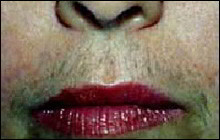
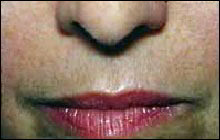
treated and gender and are spaced progressively. Concerning the moustache
and chin, an interval of 6 to 8 weeks is usual.
The
above table provides an indication of the times in-between sessions
and the number of sessions to consider in order to obtain excellent
results. The
number of sessions can be definitely more important in hairy areas
depending on male hormones, in particular in men.
| |
An
(indicative) number of sessions |
Intervals
in between each session |
| Face |
6
sessions |
2-3
months |
| Upper
lip |
6
sessions |
1,5-2,5
months |
| Chin |
5
sessions |
2
months |
| Forearm |
4
sessions |
2-3
months |
| Back |
4
sessions |
2-4
months |
| Chest |
4
sessions |
2-3
months |
| Underarm |
6
sessions |
2-3
months |
| Bikini |
4
sessions |
2-2,5
months |
| Thighs |
4
sessions |
2-4
months |
| Legs |
4
sessions |
2-3
months |
 |
| How
much does laser hair removal cost ? |
|
 |
The
price depends on the surface of the area to be treated and the number
of sessions required.
| Small area |
150 € |
chin, upper lip |
| Average
area |
200 € |
underarm, whole
face, bikini, shoulder |
| Large
area |
300 € |
arm, forearm, lower back, chest |
| Very
large area |
400
to 600 € |
legs,
thighs, back |
 |
| Is laser hair removal reimbursed by
Social Security ? |
|
 |
Laser
hair removal is not reimbursed by the French social security when it is performed for esthetic purposes. Hirsutism (excess hair) that is secondary to hormonal disease or drug intake may benefit from social security reimbursement.
A
preliminary quote is given for any treatment costing more than 300 €

1. Tina.
S. Alster. Manual of cutaneous laser techniques (Lippincott-Raven,
Philadelphia, 1997).
2. David.
J. Goldberg. Laser hair removal (Martin Dunitz, London, 2000
|